Wondering how much down payment for a house in Kenya you need? Many buyers assume they must save 100% of the purchase price before they can even start looking at properties. Thankfully, that is not how the modern real estate market works. In most cases, you only need a percentage of the property’s value upfront to secure your home.
By understanding how down payments work across different financing options, you can move into your property much faster than you think. Let’s break down exactly what you need to prepare, how your financing choice affects your upfront costs, and the sneaky hidden expenses you need to budget for.
How Much Down Payment Do You Need?
Most home buyers in Kenya need a down payment of 10% to 20% of the property’s purchase price. The exact amount depends on whether you’re buying through a bank mortgage, a SACCO, or a developer’s payment plan.
For example, if you are eyeing a modern 2-bedroom apartment valued at KES 10 million, you should plan to have a bare minimum of KES 1 million to KES 2 million saved exclusively for the deposit. However, the exact amount you will need depends entirely on how you finance the rest of the purchase.
Down Payments by Your Financing Option
Every financing path brings its own set of rules. The route you choose dictates the chunk of cash you must lay down on day one.
Commercial Bank Mortgages (10% to 20% Down)
If you apply for a residential mortgage with major commercial banks like KCB, Stanbic, NCBA, or Equity Bank, expect to lay down a 10% to 20% deposit. The bank covers the remaining 80% to 90% of the cost. Keep in mind that banks look closely at your steady income. Under Central Bank of Kenya guidelines, your monthly mortgage repayment cannot legally exceed one-third of your net salary.
SACCO Housing Loans (5% to 10% Down)
Many smart buyers skip commercial banks entirely and turn to housing SACCOs like Stima, Safaricom, or Kenya Police SACCO. If you have built up strong savings multipliers with them, their entry thresholds are remarkably friendly. Depending on the SACCO’s lending policy and your savings history, some may require as little as 5% to 10% while others may have different requirements.
Off-Plan Developer Installment Plans (20% Booking Deposit)
When you buy off-plan, you purchase the property before or during its construction phase. For premium urban projects in Nairobi, developers typically ask for a 20% booking deposit to lock in your unit at introductory pricing. The best part? You do not need a bank. Developers let you pay the remaining 80% balance in flexible, interest-free installments across the 24-to-36-month construction window.
How to Calculate the Right Deposit for Your Budget
Deciding how much cash to lay down is a balancing act. You have to look honestly at your current savings versus your monthly cash flow.
- The Minimum Deposit: Putting down the absolute minimum (like 10%) keeps your initial financial burden light, leaving your emergency funds intact. On the flip side, a lower down payment means you take on a much larger loan, which guarantees heavier monthly mortgage payments or steeper developer milestones later.
- A Larger Deposit: If you can afford to pay 30% or 40% upfront, you unlock massive advantages. You get lower, highly manageable monthly installments, save millions of shillings in compounding interest over a long-term mortgage, and gain serious leverage to negotiate a lower overall purchase price with the seller.
The golden rule? Never stretch your bank account so thin just to get through the front door that you are left stressed about next month’s bills.
Hidden Upfront Costs That Catch Buyers Off Guard
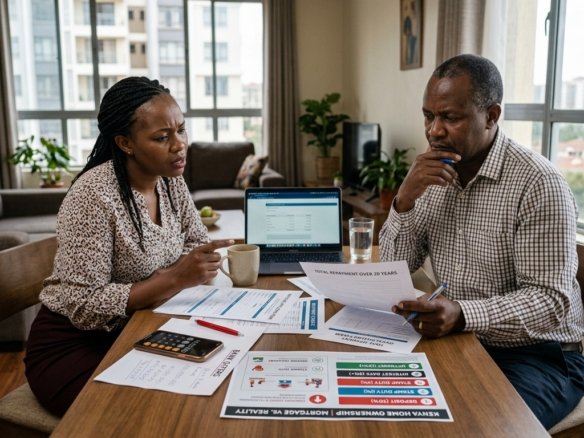
Here is a hard truth: if you only save the down payment, your transaction will stall. You need a separate cash buffer roughly 7% to 8% of the property value—to cover mandatory government taxes and legalities:
- Stamp Duty (4%): The Ministry of Lands charges a mandatory 4% Stamp Duty for urban properties. The Ardhisasa platform handles this digital payment when you register your transfer of ownership.
- Legal and Conveyancing Fees (1% to 2%): You must hire an advocate to perform title searches, review the sale agreement, and handle the legal transfer.
- Valuation and Processing Charges (KES 15,000 – KES 50,000): If you use a mortgage, banks charge a 1% facility fee and require a professional, independent property valuation before they release the funds.
The Biggest Deposit Mistake to Avoid
The most damaging mistake you can make is walking away from the closing table completely “house poor.” Draining every single cent from your bank account to hit a massive down payment goal leaves you incredibly vulnerable.
Always keep an emergency reserve untouched. After paying your deposit and transaction fees, you still need liquid cash to handle moving expenses, utility connection deposits, minor interior fit-outs, or periods where the apartment sits vacant before a tenant moves in.
Frequently Asked Questions
Can I use my retirement savings for a down payment?
Yes. Under Retirement Benefits Authority (RBA) regulations, you can utilize up to 40% of your accumulated pension savings to buy a residential house, though strict structural rules apply.
Is my down payment refundable if the project stalls?
This depends entirely on your Sale Agreement. Make sure your advocate inserts a clear Escrow Clause specifying exactly how you get your deposit back if the developer misses construction milestones.
Do developers accept foreign currency for down payments?
Absolutely. Most premium developers routinely accept US Dollars (USD), Euros, or British Pounds (GBP). For Diaspora buyers, paying a larger deposit upfront in foreign currency is a brilliant way to hedge against local currency fluctuations.
Secure Your Next Investment with Palmora
The amount you need for a down payment depends on how you plan to finance your home. Whether you’re using traditional bank loans, SACCO mortgages, or off-plan payment plans, understanding the upfront costs helps you budget confidently and avoid unexpected expenses during the buying process.
Explore Palmora Properties’ latest residential listings today, or reach out directly to our advisory team to structure a customized payment plan that protects your wealth and fits your budget perfectly.


Join The Discussion